
How China Sleepwalked into Meritocratic Absolutism
by Erik Wang
Few topics fascinate social scientists more than “big institutions,” those with profound political, social, or economic consequences over the long run. Perhaps even more fascinating is the question of how such institutions were able to emerge in the first place, given that their potential disruptions to the status quo would likely provoke resistance from vested interests.
In our recently published book, The Political Economy of China’s Imperial Examination System, available via Open Access as part of the Cambridge Elements in Political Economy, Clair and I tackle this question by investigating the most quintessential institution in Chinese history, the imperial civil service exams (科举, hereafter Keju). The examination system served as a method of recruiting officials for the imperial government through a standardized written test open to most males. Recent empirical evidence indicates that the maturation of Keju in the Tang Dynasty (618-907 CE) saw educational credentials gradually replace aristocratic pedigree as the primary factor in political selection, and that the positive effect of Keju on social mobility persists even into the 21st century.
We are motivated by the comparative implications of exam-based political selection methods for political stability and ruler survival across Europe, the Middle East, and Asia. Our book conducts a regression analysis covering 4,119 rulers across 112 historical states from Europe to Asia spanning the 1st through 18th centuries CE. We exploit the fact that a few other East Asian countries also adopted Keju from China through institutional diffusion. Our results reveal a positive relationship between the establishment of civil‑service examination systems and improvements in ruler stability. Strikingly, the magnitude of this association is comparable to the impact observed for the rise of parliamentary systems in Europe.
This echoes the well-known observation by Blaydes & Chaney that ruler duration in Europe outpaced that of the Muslim world since the 9th century. They attribute this divergence in political stability to the emergence of parliaments in Europe, which helped resolve conflicts between rulers and elites through institutionalized negotiation. Our cross-national findings suggest the intriguing possibility that the same outcome of political stability could be achieved through diverse institutional solutions. In Western Europe, parliaments stabilized regimes by placing constraints on rulers and facilitating peaceful ruler-elite bargaining. In East Asia, the establishment of exam-based political selection improved political stability by enhancing monarchical power. In the Muslim world, where neither institution took root, ruler stability remained relatively low after the medieval period.
This cross-national empirical regularity uncovered here invites a mechanism question: what, exactly, did the exam institution do to strengthen monarchical stability? Peng Peng’s excellent article in the Journal of Historical Political Economy emphasizes ideational power: by drilling officials in a shared Confucian canon, the exams standardized moral vocabularies, aligned elite loyalties with the throne, and reproduced a culturally coherent governing class.
Our book, on the other hand, reveals a more hard-edged logic in the power calculus of the ruler and the elites: by widening access to office and increasing the replaceability of political insiders, Keju, or the recruitment of officials via open, competitive examination, strengthened the Chinese ruler’s bargaining position against the most powerful political elites.
To elaborate on the political logic of Keju rooted in mobility and access to power, our book makes two arguments:
1) Keju contributed to political stability in imperial China, particularly by consolidating monarchical power through the “democratization” of access to political office beyond a narrow group of top elites.
2) The emergence of Keju was so gradual, ad hoc, and noisy that neither monarchs nor elites were likely to have anticipated the long-run implications described in (1) during the institution’s early development.
Expanding the “Selectorate” to the Broader Elites
Argument 1 draws on insights from the “selectorate theory.” By recruiting candidates for political office based on exam performance rather than social status or family wealth, Keju broadened access to politics beyond the top political elites. As the size of the “selectorate” in imperial China expanded through Keju, each member within the monarch’s ruling coalition became more easily replaceable and therefore more dependent on the monarch.
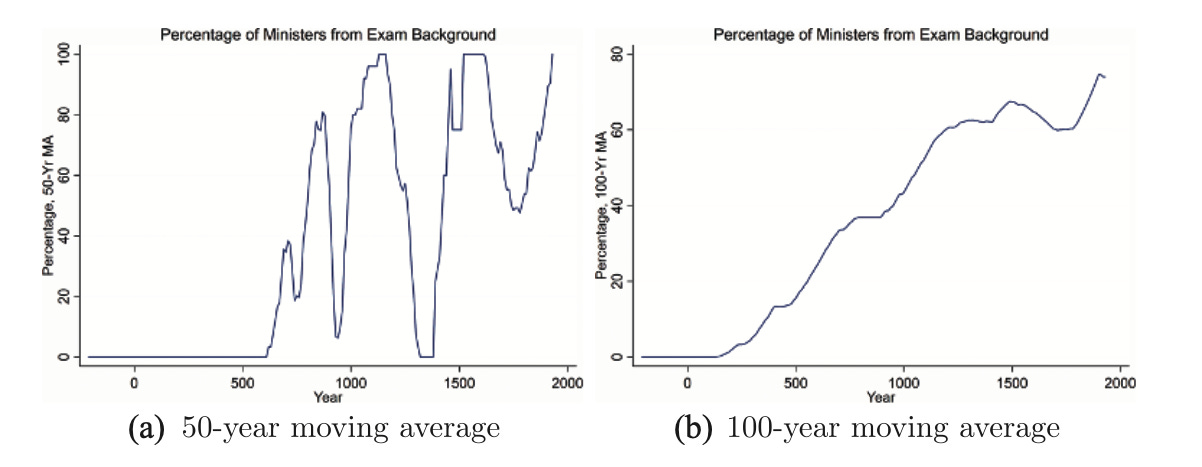
Analyses of data covering over 70,000 examinees and more than 1,500 ministers support this argument from multiple angles. Among the many pieces of evidence in the book, we highlight just two in this essay. The figure below (Figure 9 in the book) shows the steadily increasing proportion of ministers—those who held the highest political office in imperial China—who were recruited through the examination system, from its institutional inception in the early 7th century CE to its abolition in 1905. It underscores Keju’s ascendancy as the primary pathway to top political power.
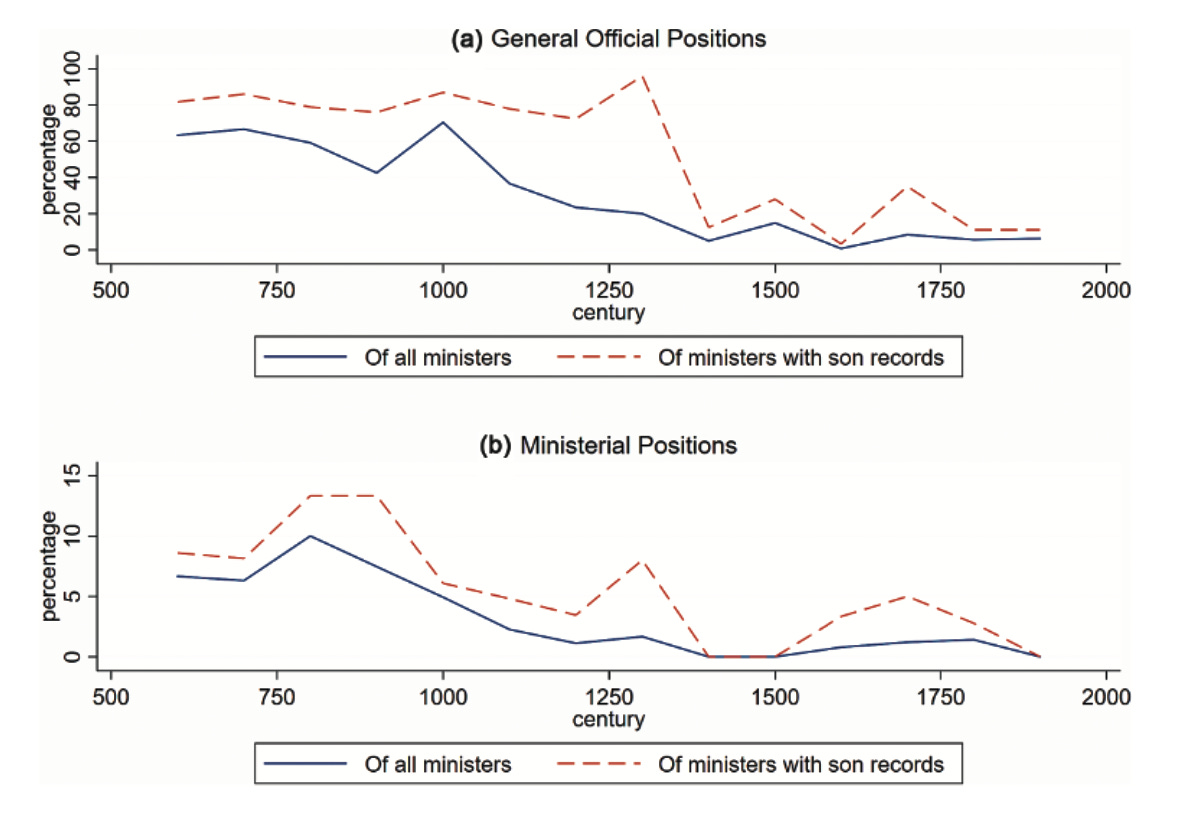
As we continue to focus on ministers and their descendants, another striking pattern emerges. As Figure 11 in the book (above) shows, the percentage of ministers with at least one son who secured a government position declined sharply following the rise of Keju, eventually averaging just 5.6% after the 16th century. A similar downward trend is evident in the proportion of ministers whose sons replicated their father’s achievement of becoming ministers themselves. These patterns clearly indicate that the intergenerational reproduction of China’s top political elites became increasingly difficult over the 1,300-year span of the Keju era. Conversely, emperors appear to have drawn from an increasingly broad pool of candidates for political office.
Of course, Keju wasn’t entirely fair—many commoners lacked the resources or time (away from agriculture) to prepare for the exams. Nor was it the only route to officialdom, though it was the most prominent, as Peng points out in her article. Our point is that, for the top political elites, those most capable of causing troubles for the monarch, Keju clearly undermined their dominance by broadening access to political power beyond their ranks. Our book calls the Keju era “proto-meritocratic.”
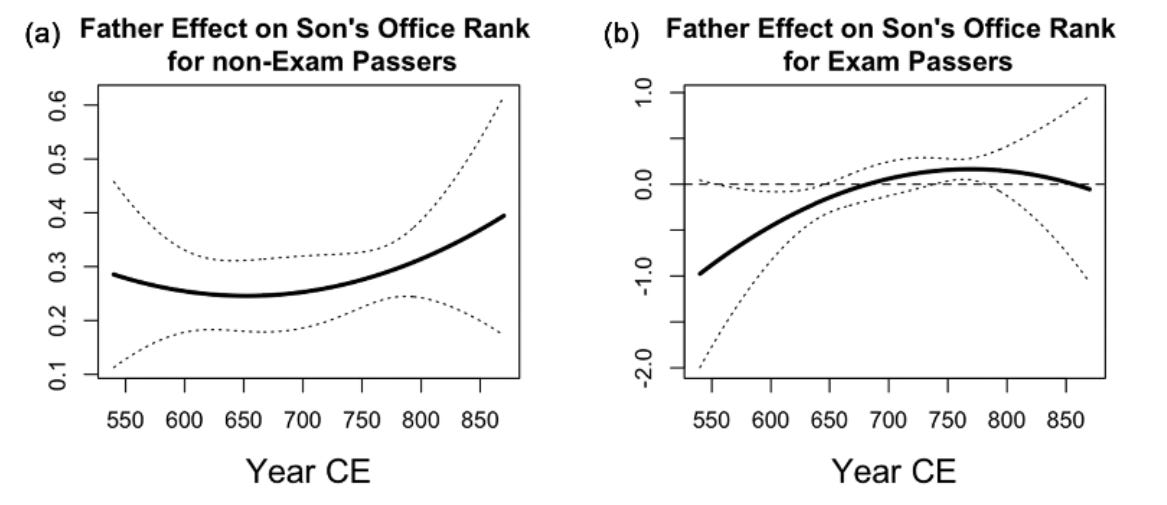
More granular data from 3,640 epitaphs of individuals buried during the Tang Dynasty (7th to 9th centuries CE) offer further insight into Keju’s “equalizing” role at the micro level. Following the sociologists’ approach in studying the equalizing effect of education, we divide the epitaph sample into two groups: sons with a Keju credential and those without. We then estimate the intergenerational association in career outcomes while controlling for a wide range of sociopolitical confounders. Figure 3(a) in the book (below) shows a consistent relationship between father’s office rank and son’s office rank among sons without a Keju credential. However, among those who passed the Keju, this intergenerational link is no longer statistically significant (Figure 3(b) in the book, also below). In other words, once an individual succeeded in the Keju, family background was no longer a meaningful determinant of political success, as measured by office rank.
Gradualism and Noise: Why Didn’t the Most Powerful Elites Resist Keju?
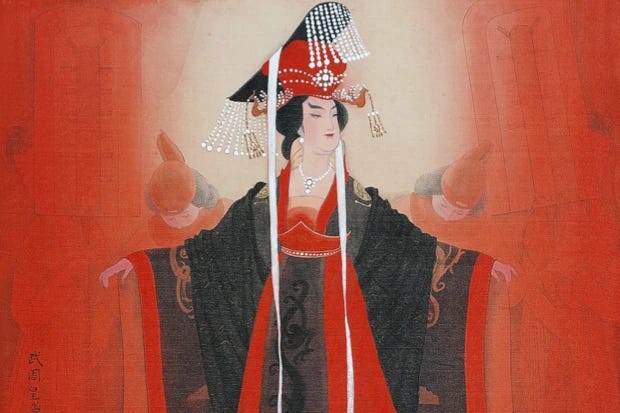
Given the above analyses, it becomes all the more intriguing that such a transformative institution, one that clearly benefited the monarch, faced little resistance from the most powerful political elites at the time it was taking shape. Our book highlights what is perhaps the most important turning point in the history of Keju: in 622 CE, when the first emperor of the Tang Dynasty formally allowed individuals to self-nominate and participate broadly in the exams, which had previously been restricted to those nominated by senior government officials. This moment of “selectorate expansion,” however, met with minimal resistance from the incumbent political elites. Later, when Empress Wu Zetian further promoted Keju as a primary pathway to top political office in the late 7th century CE, resistance from aristocrats remained limited. Our book goes to great lengths to rule out the possibility that the lack of observed resistance in both instances is simply due to missing records in the historical sources.
What, then, explains the lack of aristocratic resistance? A natural suspicion is that Tang aristocrats might have continued to dominate officeholding and, crucially, the Keju examinations themselves. But the evidence increasingly points in the opposite direction: aristocratic advantages in Keju have been overstated, and Keju was already undermining aristocratic political dominance by the early-to-mid Tang. In 2024, Fangqi Wen, Michael Hout, and I published an article in the Proceedings of the National Academy of Sciences that uses epitaph data (the same dataset employed in this book) to document the rising importance of Keju and the declining premium of aristocratic pedigree in political selection during the Tang Dynasty. The book’s findings on Keju’s “equalizing” role (mentioned above) further deepen this understanding.
Our book also presents detailed evidence that the perceived aristocratic advantage in passing the Keju exams is largely overstated. We also point out that, in fact, Tang policymakers adopted various forms of negative affirmative action against the scions of top political elites, limiting their ability to convert family background into exam success and helping preserve Keju’s “equalizing” function. Taken together, these findings debunk the prevailing myth that Keju in the Tang was coopted by the aristocracy. The more accurate conclusion is the reverse: Keju had already begun to erode aristocratic dominance in political selection well before the late Tang.
The absence of resistance, we argue, can be explained by the gradual, ad hoc, and often opaque nature of Keju’s ascent. Our book traces the “deep roots” of Keju to much earlier bureaucratic recruitment practices dating back to the Han Dynasty (202 BCE–220 CE). During the Han, officials were nominated based on perceived moral and intellectual merit and then subjected to centralized examinations. Although these examination-based methods were later eclipsed by pedigree-based selection in early medieval China, they never disappeared. In fact, a revival began in the late 5th century, gaining further momentum under regimes whose officials’ descendants would go on to found the Tang Dynasty. Our book details how Keju, as it eventually emerged, was the natural outgrowth of a longue durée of gradual institutional evolution over centuries of Chinese history.
The selectorate expansion in 622 CE, as we further point out through qualitative analysis of historical records, likely emerged as an improvised solution to an urgent administrative problem: the newly established Tang Dynasty faced severe shortages in local officials but lacked reliable information to identify competent candidates. Allowing self-nomination to participate in the exams—an innovation that, in hindsight, significantly broadened access to political office—was likely perceived as a pragmatic adjustment to a logistical challenge, not a revolutionary institutional shift. Within the broader arc of bureaucratic development, the 622 reform likely seemed incremental, building upon past precedents and technical needs. It therefore provoked little contemporary elite backlash.
In short, the slow-moving, technocratic nature of institutional change up to 622 CE, combined with the immediate pressures it sought to address, created too much “noise” for incumbent elites to detect Keju’s long-term implications for their fortunes. Similarly, when Empress Wu further elevated Keju’s primacy in the late 7th century, the process unfolded gradually and amidst enough ambiguity to prevent any organized opposition from forming.
Keju as a Self-Enforcing Institution
Keju ultimately became self-enforcing due to two major political developments following the devastating civil war of 755 CE, both of which “locked in” elite incentives to participate in the examination system.
The first was the rise of provincial secessionism. In response, Tang emperors increasingly appointed officials with proven loyalty to the central government as governors. A Keju credential signaled such loyalty—it reflected a family’s investment in the dynasty and in literary preparation aligned with state ideology. As provincial posts often served as pathways to high-ranking national positions, elites’ participation in Keju heightened.
The second development was the growing importance of edict drafters as stepping stones to the position of Chief Minister. The administrative urgency following the 755 rebellion prompted emperors to bypass the slow-moving formal bureaucracy. Instead, they relied on trusted edict drafters to rapidly implement policies. Over time, experience in edict drafting became a de facto prerequisite for elevation to Chief Minister, the top political office beneath the emperor. Elites, recognizing this pathway, increasingly invested in excelling at the Keju, which rigorously tested the literary and rhetorical skills essential for edict drafting.
The rise of Keju was a case of gradual institutional change. A series of incremental policy tweaks to address immediate concerns slowly evolved into a defining institution of imperial China. Despite its profound consequences, most notably a fundamental shift in ruler-elite relations, the ascendancy of Keju met little resistance, precisely because of its gradualism and ambiguity. The 7th century was when China sleep-walked into a proto-meritocracy that would entrench monarchical absolutism for more than a millennium.
Erik H. Wang is an Assistant Professor in the Wilf Family Department of Politics at New York University (NYU). He does research on state-building, bureaucracy, and historical political economy.