The Political Effects of Hosting Internal Evacuees
by Jean Lacroix and Ricardo Pique
Recent bombings in Iran and Lebanon have displaced hundreds of thousands of civilians. These are not isolated cases: the number of conflict-induced internally-displaced persons (IDPs) has almost doubled between 2014 and 2024, from 38 million in 2014 to 73.5 million in 2024, according to the Internal Displacement Monitoring Center. Our work shows that even temporary displacements may redefine identity boundaries and thereby impact post-conflict political behavior. Hence, while those displaced may return to their homelands, a new divide may overshadow long-term prospects for nation re-building and durable peace.
Intergroup contact theory suggests that hosting IDPs differs in important ways from hosting foreign refugees. In the former case, value convergence between locals and guests is more likely due to closeness in their social status and common inter-group goals, among other factors (Allport, 1954). Yet, exposure to a domestic out-group may still alter the salience of demographic attributes which shape inter-group boundaries, triggering an identity response among locals (Bonomi et al., 2021; Fouka and Tabellini, 2022).
Evacuations in WWII France
Estimating the causal effect of IDPs is challenging because, as with foreign refugees, their settlement patterns are endogenous to local characteristics. In addition, displacement may lead to permanent resettlement, so observed changes in behavior could be the product of demographic and economic re-composition, rather than hosts’ responses to out-group exposure.
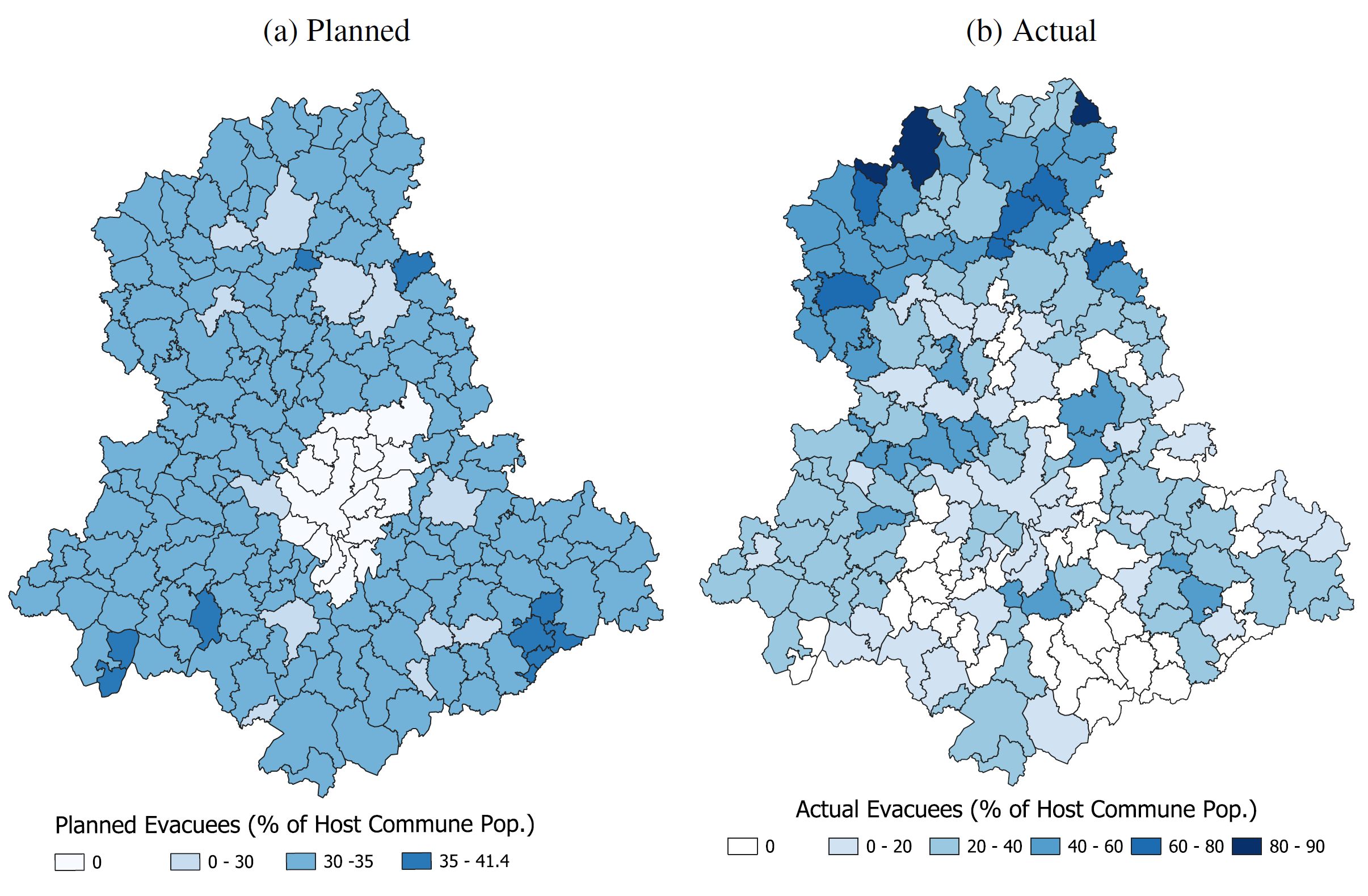
Our paper addresses these concerns by leveraging the characteristics of the WWII French temporary civilian evacuation for the French-German border zone. At the onset of the war, French authorities implemented a large-scale evacuation plan targeting the border population. Among the evacuees, Alsatians from the department of Bas-Rhin were sent to the south-west department of Haute-Vienne, more than 700 kilometers away from their homes. According to the Haute-Vienne reception plan, refugees would be spread uniformly across the department (see Panel A of Figure 1). In practice, however, the massive and unexpected influx of evacuees from the border “front zone” – the area between the Maginot line and the border – disrupted the plan. This halted the evacuation of the “rear zone”, a strip of land immediately to the rear of the Maginot line.
Consequently, host municipalities matched with the Alsatian front zone in the reception plan received significantly more evacuees than those matched with the rear: front-zone assignment increased the share of evacuees among locals by 22.8 percentage points. Our identification strategy exploits this variation (see Panel B of Figure 1). It uses the origin zone to which host municipalities were matched as an instrumental variable for the share of evacuees hosted.
Figure 1: Planned and Actual Geographic Distribution of Evacuees in Haute-Vienne.
What was the hosting experience like for Haute-Viennois? Locals had to share public spaces and, in many cases, their own homes with evacuees. Given the department’s relative poverty, the sudden increase in population placed considerable strain on local resources. At the same time, cultural differences meant that evacuees had to maintain separate institutions, including their own schools and churches. Alsatians were French citizens but had their own regional identity. Inter-group communication was hindered as their knowledge of French was limited: they spoke a dialect close to German, a fact that earned them the nickname “ya-ya” among locals (Bernussou, 2014). Moreover, whereas most of southwestern France was relatively secular, evacuees were, for the most part, devout Christians and more likely to support right-of-center parties. Furthermore, Alsace had been under German rule between 1870 and 1918. Still, evacuees and hosts co-existed peacefully until the former returned to their land a few months after the June 1940 Armistice. Only a negligible fraction of Alsatians permanently settled in the French interior.
Consequences of Hosting Co-citizen Out-groups
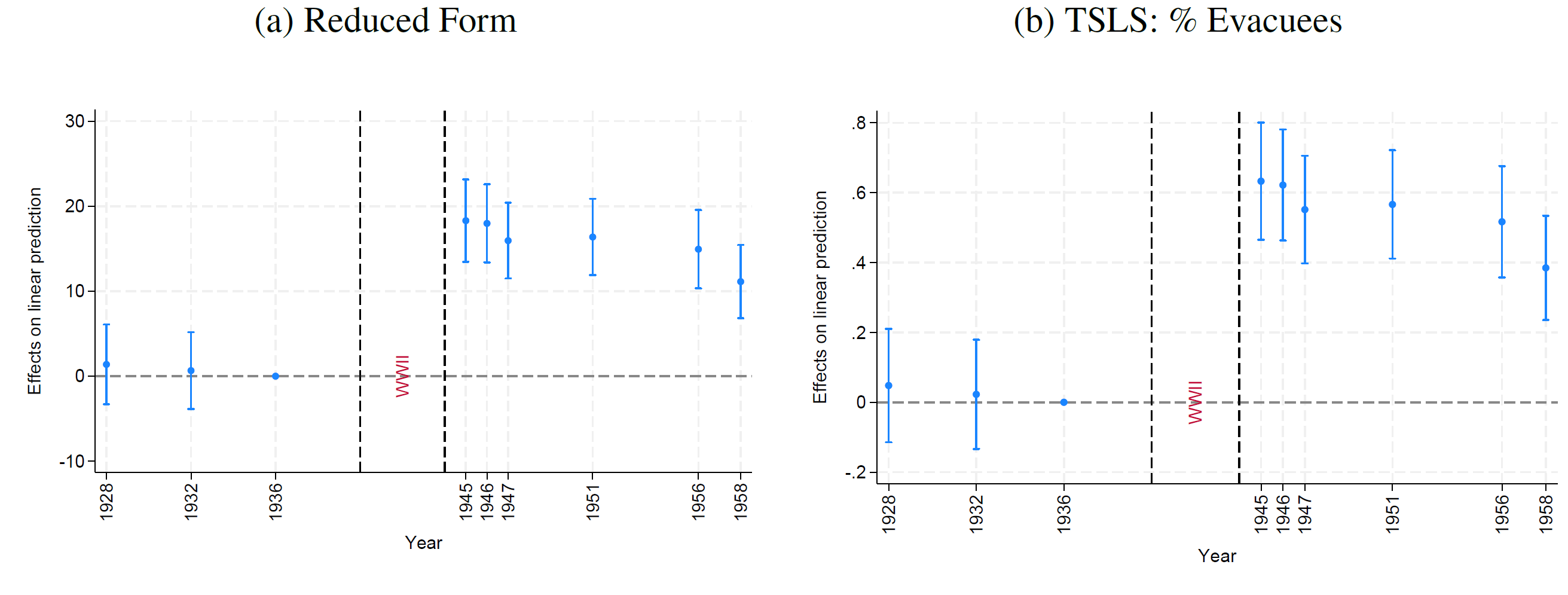
We show that temporarily hosting IDPs had important political consequences: municipalities that hosted more Alsatian evacuees experienced an increase in support for left-of-center parties, the dominant political group in the area, after the war. The peak estimates in the late 1940s imply that increasing the share of evacuees by 10 percentage points increased the left-of-center vote share by around 2 percentage points. Difference-in-differences estimates show that while there are no differential trends in prewar vote shares, there is a shift towards left-wing parties in areas matched to the front zone (see Figure 2).
Figure 2: Effect of Evacuees on Left-wing Vote Share - DiD Reduced Form and Second-Stage Estimates
What could have produced this shift in political behavior? Based on the literature, we explore three main mechanisms. First, while the majority of Alsatians were right-wing and locals were predominantly left-wing, some left-wing evacuees may have transmitted left-wing values to their hosts. Second, hosting refugees exposed locals to the costs of war and foreign aggression, consequently influencing political behavior. Third, inter-group contact can change the salience of demographic attributes and redefine inter-group boundaries (Fouka and Tabellini, 2022; Fouka and Serlin, 2026). In particular, exposure to a co-citizen out-group may have strengthened local identity among hosts at the expense of a national one. This identity response may then have translated into shifts in political behavior. In our context, this means that the greater the socioeconomic distance between Alsatian evacuees and their hosts, the more salient the difference between the two groups. As this salience increases, the more likely the political minority among hosts is to converge towards the majority’s behavior and to move away from that of the out-group of evacuees.
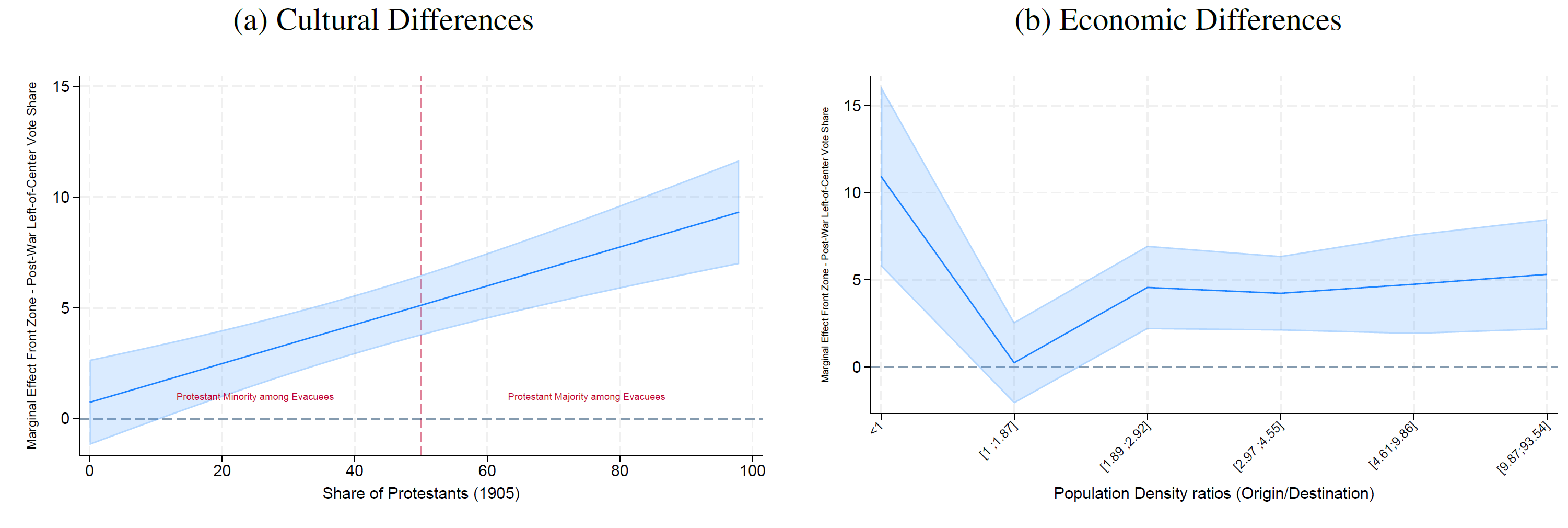
An analysis of the treatment effect provides evidence supporting this last channel: Figure 3 shows that hosting evacuees increased left-wing vote share when internally-displaced Alsatians differed most from their hosts. This was the case when IDPs were more likely to be Protestant (Panel A of Figure 3), or when urban (rural) Alsatians were hosted by rural (urban) hosts (Panel B of Figure 3). We also find a greater shift to the left where pre-war host left-wing support was stronger. Hence, it appears that the local pre-war right-wing minority changed their political behavior to better-fit the left-wing majority following an identity response to Alsatian exposure.
Figure 3: Effect of Hosting IDPs by Inter-group Socioeconomic Differences
Additional results support this explanation. The presence of evacuees led to an increase in post- war civic organizations focused on local recreational activities and the defense of local interests. Similarly, the negative effect on the vote share of right-of-center parties is largely driven by a decline in support for the MRP (Mouvement Re´publicain Populaire), a center-right party with key leaders of Alsatian descent. Finally, the presence of other French refugees, culturally closer to the hosts, did not produce the same effects.
Our results highlight the lasting consequences of temporary exposure to IDPs. These impacts are another hurdle countries must overcome post-conflict. Internal displacements are not just a by-product of conflicts, but another potential mechanism through which conflict begets conflict (Bohnet et al., 2018). IDPs may shape political behavior in the long run as hosts fall back on local identities. These reactions may come at the expense of national unity and influence the success of post-war reconstruction and nation rebuilding.
Jean Lacroix is an Associate Professor in Economics at Université Paris Saclay and a Research Affiliate at CESifo. His research lies at the intersection of Political Economy and Economic History and calls on methods from Economics, Political Sciences, and History. He is particularly interested in post-conflict societies, political transitions and elite persistence.
Ricardo Pique is a Visiting Assistant Professor at Texas A&M University, Mays Business School. His research focuses on the Political Economy of Development and Economic History.
Thanks for reading! Subscribe for free to receive new posts and support my work.